13 October 2026·12 min read
Escapade two: Fellow Amongst Fellows
As usual, some original audio featuring Lloyd’s singing. I recommend this one for calm before sleep.
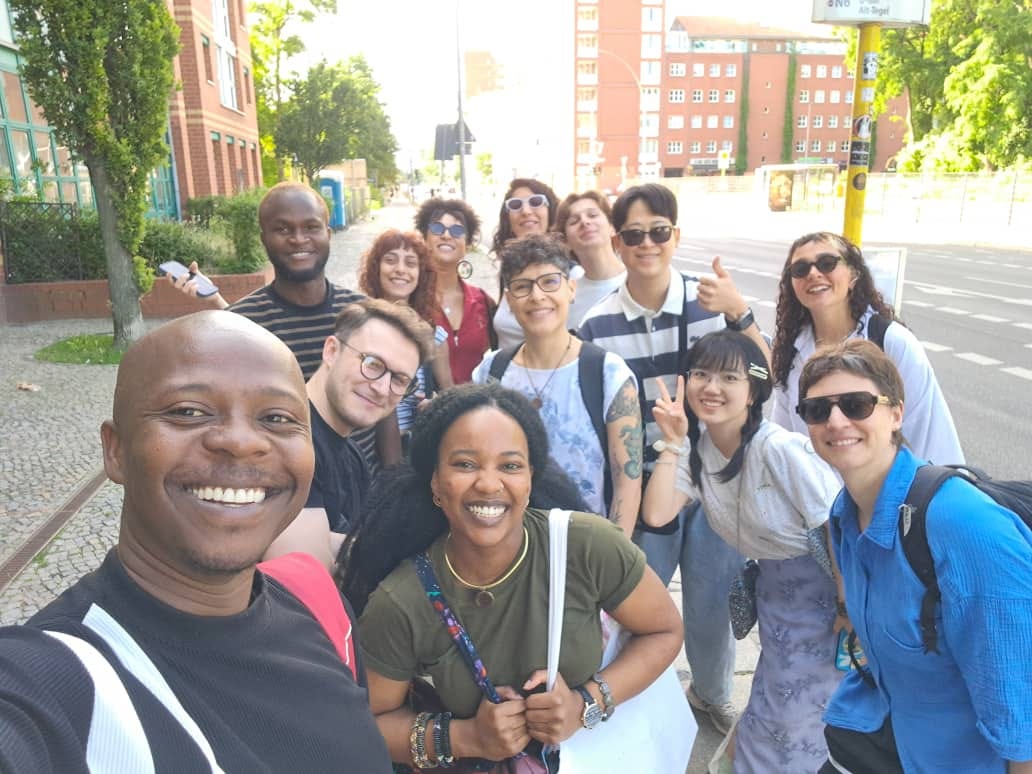
In one of the ITI Academy workshops led by Lloyd Nyikadzino, we stood in a circle and said everyone’s name. Not in the manner that you would in quick everyday interactions. When someone introduces themselves you might remember them, you hear their name but probably forget it soon after, or have a clumsy reproduction if the name is too difficult to pronounce. Within this workshop, we had to learn each other’s names earnestly. The task was specific: going around in a circle, you were asked to say your name and invite the group to repeat it after you. The chorus was supposed to reproduce exactly what you said. If not, they had to repeat it over and over until they got it right. Only then could we move to the next person.
A name carries someone’s story. The pronunciation tells you where they come from and exposes their tongue and their home. If you go a step ahead and indulge in name numerology, you can assign extensive meaning-making to a name. Whether granted to you at birth or a fresh label that you have chosen to acquire, honouring your name allows you to be seen.
Because my name sounds peculiar, I often get two reactions: “Wow, that’s a beautiful name!” or “Interesting, where is it from?” I often find myself repeating it to make sure others have got the right pronunciation and soon after talking about the lost origin of ‘Gisemba’, the odd connection to German nuns with ‘Ursula’ and trying to reconstruct what my parents are like to have given me such a name. My experience has also been that when people struggle to pronounce your name, or insist on their own idea of what they want to call you, you lose a bit of yourself. So when we stood in that circle and said each other’s name, some once, others several times, we had one more chance to simply see each other and not lose each other.
My father says that it is important to take care of your name. He says it travels where you haven’t been and it cannot be associated with poor behaviour. Some people don’t see you first, they hear your name, then gather assumptions. For this reason, I am always careful how I use other people’s names. The only challenge is he did not tell me what to do about gossip and ill-intent. I suppose he would say, that is none of your business…
While reflecting on what to write next, I thought a list of names you have never heard of, or people you don’t know, with profiles from my eyes would be quite boring to read. I thought if I sat with my memories a little bit longer, something condensed would come out of it. But the idea of once again spelling out each name and prompting myself to pronounce each memory, will give you a chance to enter that circle and see everyone in it.
So, I present to you: a name, a memory.
Awa Jalali:
The first morning of the Academy, I met Awa and we walked to the ‘drogerie markt’ better known as ‘dm’ to pick up some toiletries. Her charming laughter made me feel light and eased my morning as we quickly connected on the first get-to-know questions. Where are you from? What do you do? What are you interested in etc. As we rode the bus to the ITI offices, she opened a portal to a life of a world with many possibilities. A nomad by heart, the infectious peace with which she moved through the space reminded me to slow down and take time to be present. Ever so inquisitive and curious Awa moved with care that encouraged me to do the same.
Femi Adebajo:
My encounter with Femi would go as it often does with fellow Nigerians. They would meet my Kenyan self and immediately note the much calmer voice against their exuberant expressiveness. I had watched Femi present his impressive dance work on the IETM Pitchorama livestream a few days prior. This wonderful blend of contemporary dance bridging his culture and expressive movement had soul that you could feel even when he presented to us a freestyled piece.
But there is an important story to his resilient practice. It takes a lot to run a company in Africa, it takes a lot to run an artistic practice in Africa. For artists like Femi, you find yourself in Europe partly because of interest, but more importantly because it is part of the system that fuels your work. It is a challenging mode to sustain a practice but often presents as a fair trade off that our local spaces cannot always give. Even so, Femi exists and builds on this resilience and continued work that gives himself and others in his community more opportunity.
Ting Huyan:
The first evening I needed to figure out what to have for dinner before heading to a small Cumbia concert. I was lucky to be in the company of Ting to enjoy a small dinner and connect. Days later, we were on the empty dance floor together on a very warm summer night. It had been a while since I had seen such a burst of freedom and I was happy to share these moments with Ting.
Besides these small moments, I did learn much more about Chinese mobility and the ingenuity of managing censorship. In Kenya, China is a symbol of a neo-colonial power that has slowly creeped into our cities and towns. China is new products, new infrastructure, new apartment complexes or businesses. More alarmingly, the cycle of new loans the government has been taking and cannot repay. Billboards written fully in Mandarin have started to crop up in Nairobi. Between the multiple China Squares, to China town becoming a staple of Nairobi culture, it is safe to say the integration is alive and running. Even so, I have never had to think about someone living in China unless a big headline rocked the news. Meeting Ting and encountering her communal practice added dimension to my world view. Her work rooted the complexities of mobility in China was eye-opening. For more context read here about the Hukou System on how an administrative tool for population management and registration limits internal migration.
I’m not unfit, I swear! This was warm up for running after German trains.
Pavlo Koval:
One evening after close of business, I had a walk from the ITI offices to the bus stop, sharing a hearty laugh with Pavlo. We had a fun chat: would you date someone who isn’t an artist. I argued yes; I need new perspective. He said no; it’s better to have two crazy people together, the other option sounds too boring. Then, I took a photo of him at the stop and vowed to ask him this question again 10 years later. I think he won’t remember… But since this question is actually on my calendar, I’ll do it anyway.
Every time I turned to look at Pavlo, I admired his spirit. Despite the long travel hours and the continued attacks on Ukraine he continues to work with a very clear focus on building international projects. His lightness, hearty laughter and strength to continue working is the ultimate protest.
Ronja Oehler:
While I am used to travelling to Germany, I am often in Munich. Any German would tell you, the South, Bavaria, is a whole other place with its own culture. Even when I am in Berlin, I can feel the difference. While I still have many German friends, most of them are predominantly from West Germany or have been settled there for a long time. So Ronja opened a new perspective of this country that I had never seen, besides of course, travelling to Chemnitz within the same trip. It did help to have perspective from someone who had lived there about what exactly was happening in East Germany. In my project, THIS PLOT IS NOT FOR SALE, one character, plagued with white guilt and a need for suffering says, “I wish we were from DDR.” At the time, I hadn’t fully sat in the differences. It took being there to see it and Ronja pointing out various things that remain unchanged or unaffected to understand this.
We were treated to a performance of her work. I had never seen clowns like that before… what a performance!
Hamzeh Abu Alganam:
Hamzeh didn’t manage to make it to Berlin. We didn’t get to talk much because I can admit, I was feeling very shy and wasn’t one of the fellows who went beyond saying hi on the screen. If anything, Awa was most acutely aware of this and ensured he felt seen. It did help that he was well acquainted with one person from the organising team, Kavya, so he was always cared for. When he spoke to us, he was preparing to go to a wedding over the weekend, he reassured us of his positivity. The failures of the bureaucratic structures of the world never stopped him from living fully.
I watched a disciplined dancer bring something powerful to explore in the body. His capability to create reflection through time and slow movement created beauty in the grotesque. It was a state of being hypnotised as we watched him slowly change the scenes just from movement on his living room couch. I hope to experience Hamzeh in an in-person conversation or on stage in the future.
Sarah Almoneem:
When we started the days with meditation and stretching, I often looked over to watch Sarah’s movements. Of course I was secretly in awe of her flexibility, composure and calmness. It is so wonderful to watch a dancer in practice. I’d wish to move as beautifully as dancers do but I know it is a case of, ‘What you think you look like vs what you actually look like.’
I rode the last train to Chemnitz with Sarah and we shared a little about our personal lives and journeys. Much later, we were promptly matched with one of our mentors Sara Amini to collaborate on a project I am working on. I look forward to building something with Sarah and Sara.
Everyone running in Leipzig to catch the train.
You-taek Hwang:
Every time I watched You-taek switch to his laptop, to follow along with the English transcription, I was encouraged to never allow language to be a barrier to movement. This conscious choice to be in the room, perhaps asked more of him than the most of us. Following in his practice of reimagining boundaries, he had a method to work around language as a border.
He introduced us to his project Simulation of Border. This deep thinking about what borders are as an experience rather than lines reminded me a lot of the complications of borders and the trouble of their history in Africa. Participating in drawing borders together from what we experience and less of the imaginary lines ascribed to us through governments added some new reflection on the idea of how we move internationally and building solidarity.
You-taek remains a great cheerleader.
Melisa Stocco:
We closed our eyes during Melisa’s presentation and she took us through meditation to El Jardín Teatro Laboratorio. We found ourselves meeting a small theatre community in Argentina. Reminding us what it takes to build together with hope and working in small spaces rather than big cities.
We shared more laughs and thoughts about the shows in Chemnitz. On the first night in Chemnitz, we watched an Argentinian show. I told her how much I was scared of curse words… Then she told me, I was lucky! The language was much dirtier if I understood Spanish. Irony is, I really do know more insults in Spanish than in any other foreign language!
Shauna Harris:
Shauna was surprisingly always very ready for a good time and I loved the idea of it against her work around pleasure activism. Her work is communal and inherently based on rethinking activism as a place where joy can also exist. It was so important for me to see this work, not because I do anything close to this, but to be inspired and to learn from it. In a world where everything always feels so bleak, especially in relation to speaking out for what you care for, different approaches that can reimagine our interactions with each other help us to bridge gaps and construct new ways of sharing information and going against the status quo.
We did unfortunately freak out together after almost being a few minutes late for a show. Such a relief that we made it on time but very different sentiments on whether we should have run.
Because Shauna’s an actor, may it be soon when we get to catch her on screen!
Paweł Bernadowski:
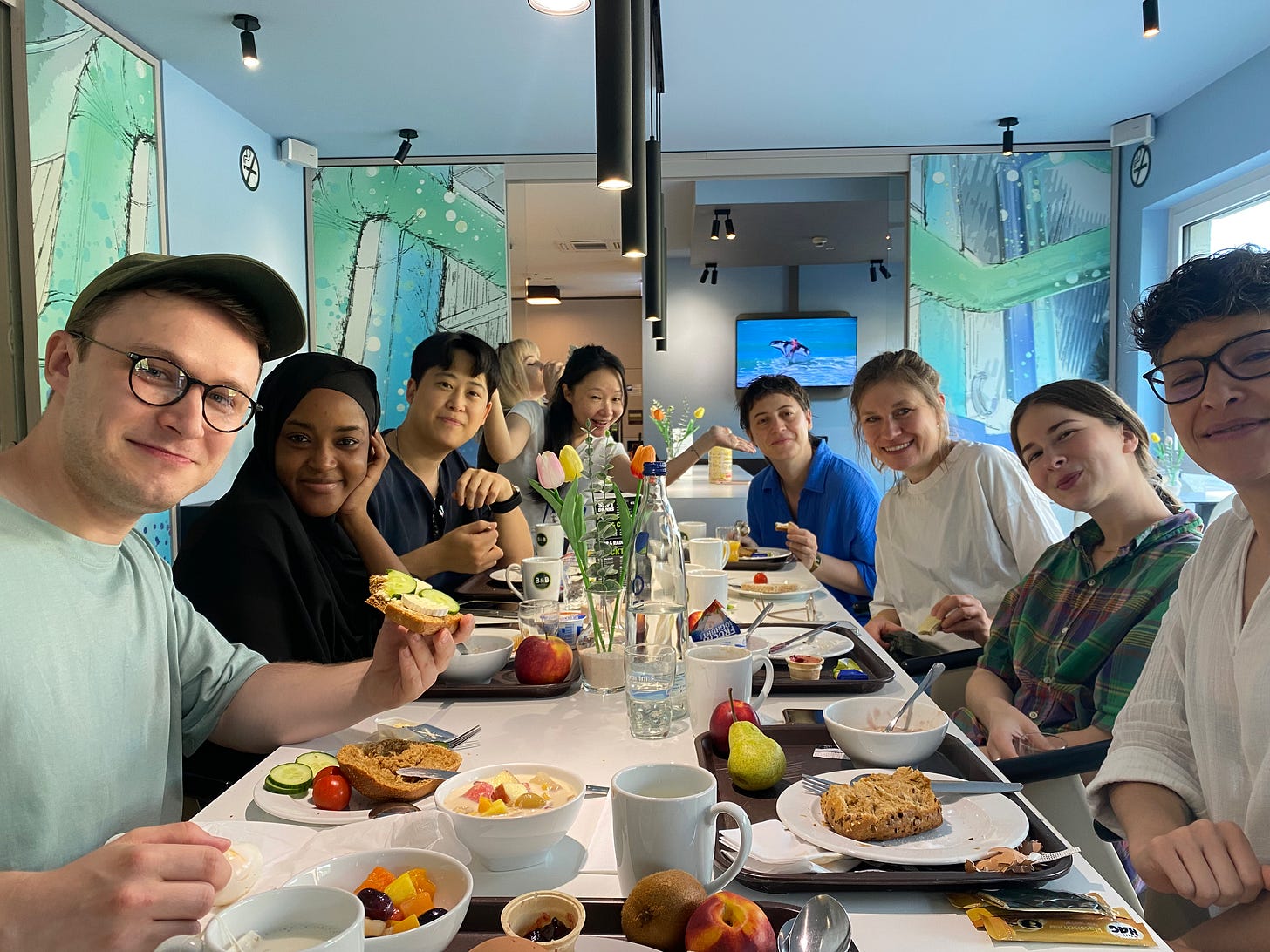
I loved sitting next to Paweł during breakfast. He was consistently puzzled by what I was eating and how I was mixing and blending different things. He did not believe that if a pineapple was sour, it would taste better if you put salt on it. Okay, no one believed me, they thought I was crazy. But in their defence, the pineapples in Berlin were so sour nothing could save them.
This was a way to ease into talking more about the world and his really fascinating projects that are all somehow connected to archives and sound. Whether whales or radio, it all prompted me to think a little bit more about vibrations in my own life.
I tried to keep this reflection intentionally untidy, because to clean it up would mean to organise my boxes of thought into clean reflections that don’t match the messiness of meeting people. Some memories I left out, some I shared. I had more time with some than others.
I hope you learn these names too and within the expanse of life have the opportunity to encounter them here or elsewhere.
If you’d like to check out all the ITI Academy profiles: https://www.iti-germany.de/en/projects/project-overview/iti-academy-week-2026/
Thanks for being here at the start! Subscribe and invite friends for the journey.